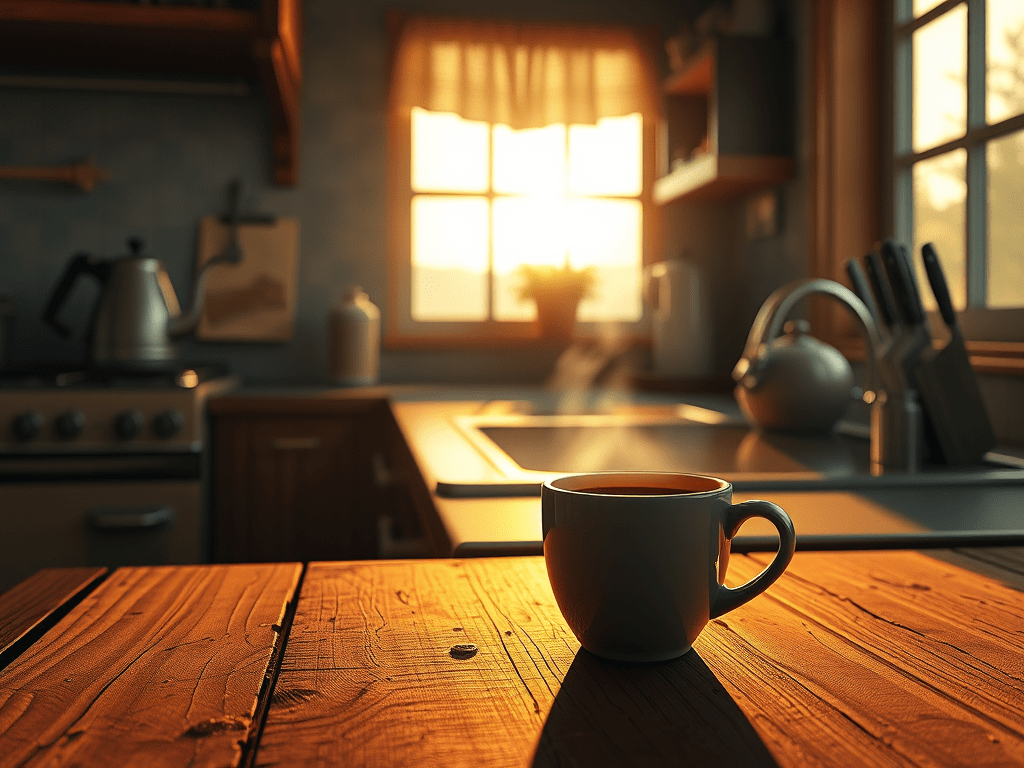
I make coffee in the quiet before the day asks anything of me.
Measure.
The scoop is heavier than it needs to be.
Pour.
Everything requires participation.
Wait.
The kettle takes too long.
I pretend I’m in love with the idea of being alive, which feels close enough most days to pass for the real thing. The kettle heats. I let it go longer than necessary. I like the moment right before it tips into impatience, when the air changes and the sound sharpens and my body remembers to pay attention.
Heat gathers in the kitchen. It presses outward from the stove, from the water, from me. I let it. I’ve always understood escalation—how to ride it, how to let it swell until every nerve wakes up and asks to be accounted for. My skin tightens around that knowing. There’s no room to step away from it. Only deeper into it.
I don’t stare at the knives resting on the counter by the stove. I know where they are. That feels different. Their presence is ordinary, domestic, almost polite—handles turned outward, as if nothing in the room has ever asked too much of me. They register through the air, through memory, through habit. Objects like that don’t need attention to announce themselves. They hum. I keep moving. The body learns how to pass danger without touching it. The body remembers everything. I move through the kitchen without giving anything more attention than it deserves.
The lighter is still in my pocket, a small insistence against my hip. I ignore it with effort. Forgetting is physical. It requires tension. I can feel the muscle of restraint working, the way you feel a stretch before it tears. I’ve always been good at pretending not to feel the weight of things that insist on being known. Heat has a way of clarifying that. So does anxiety. I learned, once, that letting something rise just shy of too far could pull me back into my body. That there is a narrow, electric space where everything sharpens—breath, sound, thought—and you remember you are here because you might not be. Still responsive. Still capable of feeling something unmistakably real.
I learned how far is far enough.
That was never about the ending. It was about the brink.
The coffee finishes brewing. I pour it too fast. I drink it too fast. I burn my tongue and feel the sharpness bloom and recede, contained but vivid. The sensation stays inside me. There is no exit.
I stand at the edge of the day the way I once stood at the edge of other things—not to fall, not to test gravity, but to be honest about the height I’m already standing at. I don’t need the rehearsal anymore. The room holds. The morning holds. My skin holds.
The light lands on the wall with unreasonable confidence. The plant hasn’t died. The floor is cold. The world keeps offering itself in small, persuasive ways, as if it trusts me to stay, quietly confident that I’ll participate.
I drink the coffee while it’s too hot.
I let the heat rise.
And this—this pressure, this awareness, this being held inside myself—is how the day begins.
 The Long Form
Leave a comment